Call now 877-643-8738


Key Points:
- Homework can be overwhelming for autistic children due to sensory challenges, executive functioning difficulties, and school-day fatigue.
- Many homework struggles are behavior-based, meaning they can be effectively supported using structured, evidence-based ABA strategies.
- Strategies shared from Get Set ABA experts during in-home, school, and parent and teacher training can significantly reduce stress and improve independence.

Homework can be one of the most stressful parts of the day for autistic children and their families. For many kids in Maryland, the end of the school day does not mean the end of the hard work. It often means more demands at home, with less support and structure.
If your child struggles to sit down and start homework, or if evenings regularly end in meltdowns, you are not alone. Understanding why autism homework challenges are so common is the first step. The next step is knowing what actually helps.
Applied Behavior Analysis (ABA) offers practical, evidence-based strategies that make homework more manageable for autistic children.
Why Do Autistic Children Struggle with Homework?
School Burnout and Fatigue
Autistic children often spend the entire school day managing sensory input, social expectations, and the pressure to behave in neurotypical ways. By the time they get home, they are exhausted.
This kind of mental and emotional fatigue makes it very hard to focus on more academic tasks. Asking a burned-out child to sit down and complete homework is like asking someone to run a second race right after finishing the first.
Executive Dysfunction
Many autistic children have difficulty with executive functioning skills such as planning, starting tasks, and organizing their time. This is not laziness or defiance.
Executive dysfunction means a child may genuinely not know how to begin a task, even if they understand the content. It can look like procrastination or avoidance, but the root cause is a neurological challenge with getting started and staying on track.
Sensory Sensitivities
The home environment is not always a calm or comfortable space for autistic children. Background noise, certain lighting, the texture of a pencil, or sounds from other rooms can all become distracting or overwhelming.
Sensory sensitivities make it difficult to concentrate and stay seated, which directly impacts homework help for autism in Maryland and the ability to complete assignments at home.

Rigidity and Perfectionism
Some autistic children have a strong need for things to be exactly right. If they fear making a mistake, they may refuse to write anything at all. Perfectionism can cause a child to erase the same sentence over and over, or to shut down completely before getting started.
This anxiety around accuracy is a real barrier that ABA homework strategies in Maryland can help address directly.
Difficulty Switching Tasks
Transitioning from a preferred activity like playing or watching TV to an unpreferred one like homework is extremely difficult for many autistic children.
The shift from the structure of school to the unstructured home environment also adds to this challenge. Without a clear routine or transition cue, children may resist or melt down.
Communication and Processing Challenges
A child may not have fully understood or correctly recorded the assignment instructions during the school day. They may also struggle to process academic concepts once at home without the classroom support they rely on.
This confusion leads to frustration, which can quickly escalate. Homework help for autism in Maryland often needs to address comprehension and communication challenges alongside the academic content itself.
Lack of Motivation or Interest
If a task is too easy, it may feel pointless. If it is too hard, it feels impossible. Either way, the child sees no reason to engage. Understanding this helps when designing effective ABA academic support in Maryland.

Key ABA Homework Strategies for Maryland Families
ABA homework strategies in Maryland focus on changing the environment and building skills gradually so that homework becomes less overwhelming and more manageable over time.
Task Analysis: Breaking Down Assignments
Large assignments are broken into smaller, clearly defined steps. Instead of telling a child to “do your homework,” you guide them through one small step at a time.
- “Open your notebook to the math page.”
- “Read the first problem out loud.”
- “Write your answer for problem one.”
This approach removes the overwhelm of seeing a full assignment all at once and makes it easier to get started.
Positive Reinforcement
Rewarding effort and completion is one of the most powerful autism study skills strategies in Maryland. Reinforcement does not have to mean big prizes.
It can be verbal praise, a short break, access to a preferred toy, or five minutes of screen time. The key is that the reward happens immediately after the desired behavior.
Visual Schedules and Supports
Visual tools help autistic children understand what is expected, what comes next, and when they will be done. Common visual supports include:
- A written or picture-based homework checklist
- A visual timer showing how long each task will take
- A “first-then” board (First: 2 math problems. Then: 5-minute break)
Visual supports give children a sense of control and predictability, which reduces anxiety around homework.
Structured Homework Routines
Consistency matters a great deal for autistic children. A structured routine signals that it is homework time and helps the child transition more smoothly.
This includes:
- A consistent start time.
- A designated quiet workspace with minimal sensory distractions.
- A set routine that stays the same each day.
Over time, the routine itself becomes a cue that reduces resistance.

Prompting and Fading
ABA therapists use prompts to help a child begin or continue a task. This might look like:
- Pointing to the first question.
- Reading the instructions together.
- Giving a verbal cue.
The goal is to gradually reduce the amount of help provided over time, a process called fading. This promotes independent work and builds confidence in autism study skills.
The First-Then Principle
Linking a less preferred activity with a preferred one helps motivate children to complete work.
For example:
- First: Finish your reading worksheet
- Then: 10 minutes of video game time
This simple framework gives children a clear reason to complete the task and something concrete to look forward to.
Token Economy Systems
A token economy is a structured reward system where a child earns tokens or stickers for completing portions of homework. Once they collect a set number of tokens, they exchange them for a larger reward.
For example, a child earns one sticker for every 10 minutes of focused work. Once they earn five stickers, they get 30 minutes of free time or a small treat. This transforms homework from something daunting into a structured, achievable routine.
Proactive Breaks
Rather than waiting for frustration to build into a meltdown, proactive breaks are scheduled in advance. Some families use a “stress thermometer” to help children identify their level of frustration and take a break before reaching a crisis point. This is a proactive approach that keeps homework sessions calmer and more productive.
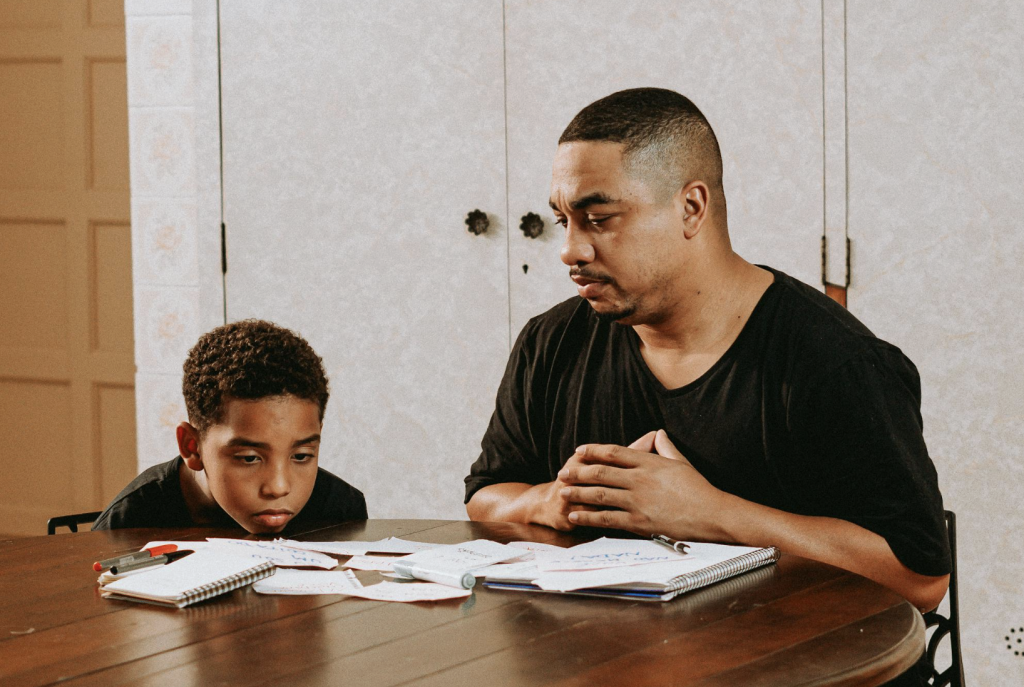
ABA Homework Strategies in Practice: Math Worksheet Refusal
Here is how ABA academic support with Get Set ABA in Maryland might handle a common scenario.
The situation: A child refuses to start a 10-problem math worksheet and becomes distressed.
The ABA approach:
- Break it down: Divide the worksheet into five sets of two problems each
- Use a visual aid: Create a checklist showing “First: 2 problems. Then: 5-minute iPad break”
- Prompt to start: Point to the first problem and offer minimal help to get going
- Reinforce immediately: Praise the child as soon as they complete the first two problems, and allow a break
- Build gradually: Over days or weeks, increase to three or four problems before each break
This step-by-step method is a practical example of ABA homework strategies in Maryland that any family can begin using at home.
Benefits of Using ABA for Homework Support
When applied consistently, our ABA academic support produces real, lasting change.
Here is what we often see with families:
- Reduced frustration: Breaking tasks down lowers anxiety and the urge to avoid work
- Increased independence: Children learn to manage their time and complete tasks with less adult prompting
- Improved focus: Structured routines and visual aids keep children on task
- Positive association with learning: Consistent reinforcement turns homework from something dreaded into something achievable
- Stronger autism study skills in Maryland: Children carry these habits into the classroom and beyond

How Get Set ABA Can Help
We understand that autism school challenges in Maryland do not end when the school bell rings. Homework is a daily battle for many families, and it does not have to be.
We offer ABA services in the home, at school, and through parent training so that strategies are consistent across every environment. This is called generalization skills, and it is a key goal of ABA therapy:
Why ‘Generalization’ Matters in ABA
This means skills learned in therapy are applied across different settings, with different people, and in new situations.
At Get Set ABA, this is essential for us. A child who learns to break down a task with their therapist needs to be able to do the same thing at home with a parent, or independently at the kitchen table.
Without generalization, skills remain limited to one setting and one person. With it, children become more capable, flexible, and independent across all areas of life.
This is why ABA services that include parent training and school collaboration produce better long-term outcomes for homework challenges and other behavioral challenges.
If your child is struggling with homework and you are looking for homework help for autism in Maryland, reach out to Get Set ABA today. We are here to help your family move from stress to success, one step at a time.

FAQs
1. Why is homework so difficult for autistic children?
Homework can be challenging due to school-related fatigue, executive functioning difficulties, sensory sensitivities, and trouble transitioning from preferred activities to academic tasks. These factors can make even simple assignments feel overwhelming.
2. How does ABA help with homework struggles?
ABA therapy uses structured, evidence-based strategies like task analysis, visual supports, reinforcement systems, and prompting to break homework into manageable steps and reduce stress and avoidance.
3. What are some simple ABA strategies parents can use at home?
Parents can use “first-then” boards, short task breakdowns, visual timers, consistent routines, and immediate positive reinforcement such as praise or small breaks to improve focus and cooperation.
4. What is a token economy system in ABA homework support?
A token economy is a reward system where children earn tokens (like stickers) for completing small parts of homework. These tokens are later exchanged for a preferred reward, helping motivate participation and consistency.
5. How can I reduce homework-related meltdowns?
Preventing overwhelm is key. Use scheduled breaks, reduce sensory distractions, break tasks into smaller steps, and offer clear expectations before starting. Catching frustration early can prevent escalation.
6. Can ABA therapy improve long-term study skills?
Yes. With consistent ABA support, children develop stronger independence, better focus, improved task initiation, and more positive associations with learning that carry over into school and daily routines.
If you’d like professional support tailored to your child’s needs, Get Set ABA can help build consistent strategies across home and school environments. Call us today: 877-6438-738.