Call now 877-643-8738

Key Points:
- Step Into a Parent-Coach Role: Use ABA strategies to support your child at home and in school.
- Make Skills Stick: Practice therapy skills in everyday routines for lasting results.
- The Power of Collaboration: Parents, teachers, and therapists working together drive meaningful progress.

What Parent Training Actually Looks Like at Get Set ABA
Most people picture ABA therapy as something that happens in a clinic, between a therapist and a child, while parents wait in the lobby. That’s not how it works here.
At Get Set ABA, parent training is built around a simple idea: you know your child better than anyone, and that knowledge becomes a powerful tool when it’s paired with the right strategies. A Board Certified Behavior Analyst (BCBA) works directly with you, not just your child, to teach practical Applied Behavior Analysis techniques you can actually use at home, in the car, at the grocery store, wherever life happens.
The training isn’t one-size-fits-all. Your BCBA takes the time to understand your family’s daily routine, your child’s specific challenges, and what success realistically looks like for you. Then the two of you build from there.
Why It Matters That You’re Involved
Here’s the truth about therapy: an hour or two of structured sessions a week isn’t enough on its own. Skills practiced in a therapy room can evaporate if they’re never reinforced anywhere else. That’s the gap parent training closes.
When caregivers understand why certain strategies work, not just what to do, they can respond consistently across all the situations a therapist will never be in the room for. Bedtime battles. Meltdowns at the restaurant. The morning rush when everyone’s already stressed.
Families who’ve gone through parent training often talk about specific turning points: the child who finally started sleeping in their own bed, the picky eater who started trying new foods without a full-scale war at the table, siblings who stopped fighting constantly and actually started playing together. These aren’t dramatic therapy breakthroughs. They’re Tuesday evening wins that add up to a genuinely different family life.
What Parents Learn
The core of parent training involves a handful of interconnected skills:
Reading the Situation: BCBAs teach caregivers to think in terms of ABC data: Antecedent (what happened right before), Behavior (what the child did), and Consequence (what happened after). Once you can spot those patterns, you stop feeling like behaviors come out of nowhere.
Reinforcement that Works: Positive reinforcement sounds simple until you’re in the middle of a tantrum and your go-to responses aren’t doing anything. Training helps you figure out what actually motivates your child and how to use that strategically.
Prompting and Fading: You’ll learn how to guide your child through a skill step by step, and then how to gradually pull back that support so they’re doing it themselves, not just following your lead.
Structured Communication: Simple tools like “First/Then” statements and visual schedules can completely change how a child responds to transitions and requests.

How Parent Coaching Looks at Get Set ABA: The Pajama Problem
Every time a parent asked their child to put on pajamas, it triggered a 20-minute tantrum that exhausted everyone and pushed bedtime later and later.
Their BCBA worked with them on a targeted plan. They started using “First pajamas, then iPad”, clear, predictable, no room for negotiation. They practiced prompting the child to pick up the pajamas, then pausing to give the child a chance to take the next step independently. Each success got immediate, specific praise.
The piece that surprised them most was learning not to react to the tantrum itself. Instead of engaging or escalating, they calmly waited it out, then reinforced the moment compliance happened. Over two weeks, full physical prompts were faded, and the child started initiating the routine with far less resistance. That’s the power of parent training; it turns a daily nightmare into a skill-building opportunity.
Other Areas Parent Training Can Target
The strategies parents learn aren’t limited to one behavior or one time of day. Common focus areas include:
- Getting a picky eater to tolerate new foods through gradual exposure and reinforcement, rather than pressure
- Building functional communication, whether that’s verbal language, gestures, or an AAC device
- Coaching social skills during playdates: taking turns, sharing, knowing how to enter a game already in progress
- Daily living skills like self-care routines, basic chores, and getting ready independently
Parents as Coaches: Including in the Classroom
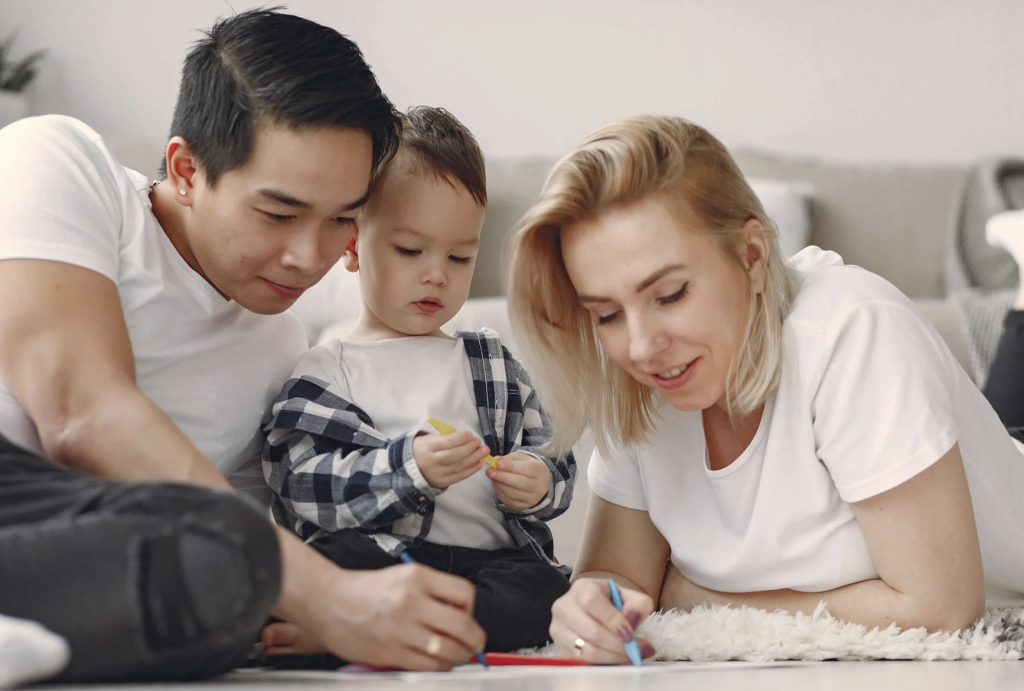
Parents are encouraged to act as bridges between home and school, sharing what works with teachers and bringing classroom strategies back home.
This looks like collaborating on IEP goals, so therapy and school are pulling in the same direction. It means showing up to team meetings not just to receive information, but to offer it; you’ve seen things teachers haven’t. It means helping teachers understand what motivates your child and why certain reinforcement systems work better than others.
The result is that your child doesn’t have to figure out two completely different sets of rules and expectations. Consistency across environments is one of the strongest predictors of lasting progress.
Don’t Forget Everyone Else in the Picture
Grandparents, babysitters, aunts and uncles, anyone who spends significant time with your child can be part of the picture. When the adults in a child’s life all respond to behavior the same way, children get clearer signals and fewer opportunities for confusion or inconsistency to undermine progress.
Caregiver education isn’t about turning everyone into a therapist. It’s about making sure the people your child trusts most are equipped to support them confidently, without accidentally reinforcing the exact behaviors you’re working to change.

Keeping Generalization Skills Alive Outside of Sessions
Getting skills to stick in the real world, not just in structured practice, is one of the trickiest parts of any intervention. The strategies parents use at home are specifically designed to help with this.
Practicing skills in natural contexts matters enormously. A child who learns to request help during a therapy activity needs to practice that same skill at dinner, at the playground, and at school.
Consistent reinforcement across those settings, from multiple caregivers, is what makes the behavior durable rather than situation-specific.
Behavior Support That Fits Real Life
Behavior challenges don’t follow a schedule. They show up during school pickup, at birthday parties, during transitions no one planned for. ABA gives families a framework for handling those moments without flying blind.
Functional communication training is often a game-changer when children learn more effective ways to express what they need; many frustration-driven behaviors drop significantly. Visual supports like schedules and charts reduce anxiety by making the day predictable. Structured routines give children a sense of what comes next, which cuts down on resistance to transitions.
These aren’t clinical tools locked behind a therapy room door. They’re practical strategies families use at breakfast, at bedtime, and everywhere in between.

The Collaborative Model
Progress accelerates when therapists, parents, teachers, and caregivers are actually in communication with each other, not just assumed to be aligned. Regular check-ins help everyone stay on the same page, catch problems early, and celebrate what’s actually working.
Therapists bring clinical expertise. Parents bring real-world knowledge of their child. Teachers bring classroom context. No single person has the full picture, which is exactly why the collaborative model works better than any of them operating in isolation.
Getting Started
If you’re ready to move from observer to active participant in your child’s therapy, Get Set ABA’s parent training program in Maryland is designed to meet you where you are. There’s no assumed expertise required, just a willingness to learn alongside your child.
Contact us to find out how we can build a plan that fits your family.
FAQs
1. What exactly is ABA parent training?
It’s a structured process where a BCBA teaches you to apply behavior analysis techniques in your own home. The goal is to help your child develop new skills, reduce challenging behaviors, and hold onto the progress made in therapy sessions.
2. What does working with a BCBA actually involve?
Hands-on coaching, not lectures. Your BCBA models strategies, watches you practice them, and gives real feedback. Most of the work is grounded in your actual daily routines rather than hypothetical scenarios.
3. What kinds of changes do families usually see?
Common wins include children gaining independence at bedtime, expanding what they’ll eat, and improving how they interact with siblings. The specific outcomes vary, but most families describe meaningful improvements in daily quality of life.
4. Will this help my child at school, too?
Yes. Parents who take an active coaching role, sharing strategies with teachers and collaborating on IEP goals, see faster generalization of skills in the classroom. A consistent approach at home and school makes a real difference.
5. What about grandparents or babysitters? They can absolutely be included. Anyone who regularly cares for your child benefits from understanding the strategies you’re using, and it prevents mixed signals that can undermine progress.
6. How do I get started? Reach out to Get Set ABA. A BCBA will assess your child’s needs, get to know your family’s routine, and build a training plan from there. Let’s get started: 877-6438-738.